Reflections from Japan
I’m on my way home now. This trip to Japan felt like much more than a vacation.
Before leaving, I was already close to burning out. Work, family, children, relationships, responsibilities — life had become a conveyor belt constantly pushing forward, leaving very little space to truly feel anything. But once the plane landed in Tokyo, feeling became the only thing I needed to do.
I still remember the chaos of my first moments after arriving. Thinking the train was about to leave, I shouted for my husband, and several people immediately turned around to look at me. I felt embarrassed, but also suddenly aware that I had truly entered a different culture. People here were quiet, restrained, orderly. Even the rhythm of the air felt different.
Tokyo is huge, bright, and crowded. But strangely, it did not make me feel more anxious, perhaps because I was not truly part of it. Instead, I found myself noticing things I normally would have overlooked: the crowds at Senso-ji Temple, the long lines for goshuin stamps, the energy of the shopping streets, the wooden prayer plaques hanging at shrines. Part of me felt resistant to how commercialized some of it seemed, yet I still found myself carefully writing down my own wishes.
Later, at Senso-ji, I stood for a long time in front of a war memorial. Reading about the civilians who died during the Tokyo air raids made me think about the immense wounds war had also left on China. In that moment, I felt deeply sad. There are no winners in war.
Then we went to Kyoto.
Kyoto felt entirely different from Tokyo. Tokyo shimmered brightly; Kyoto felt soft and muted.
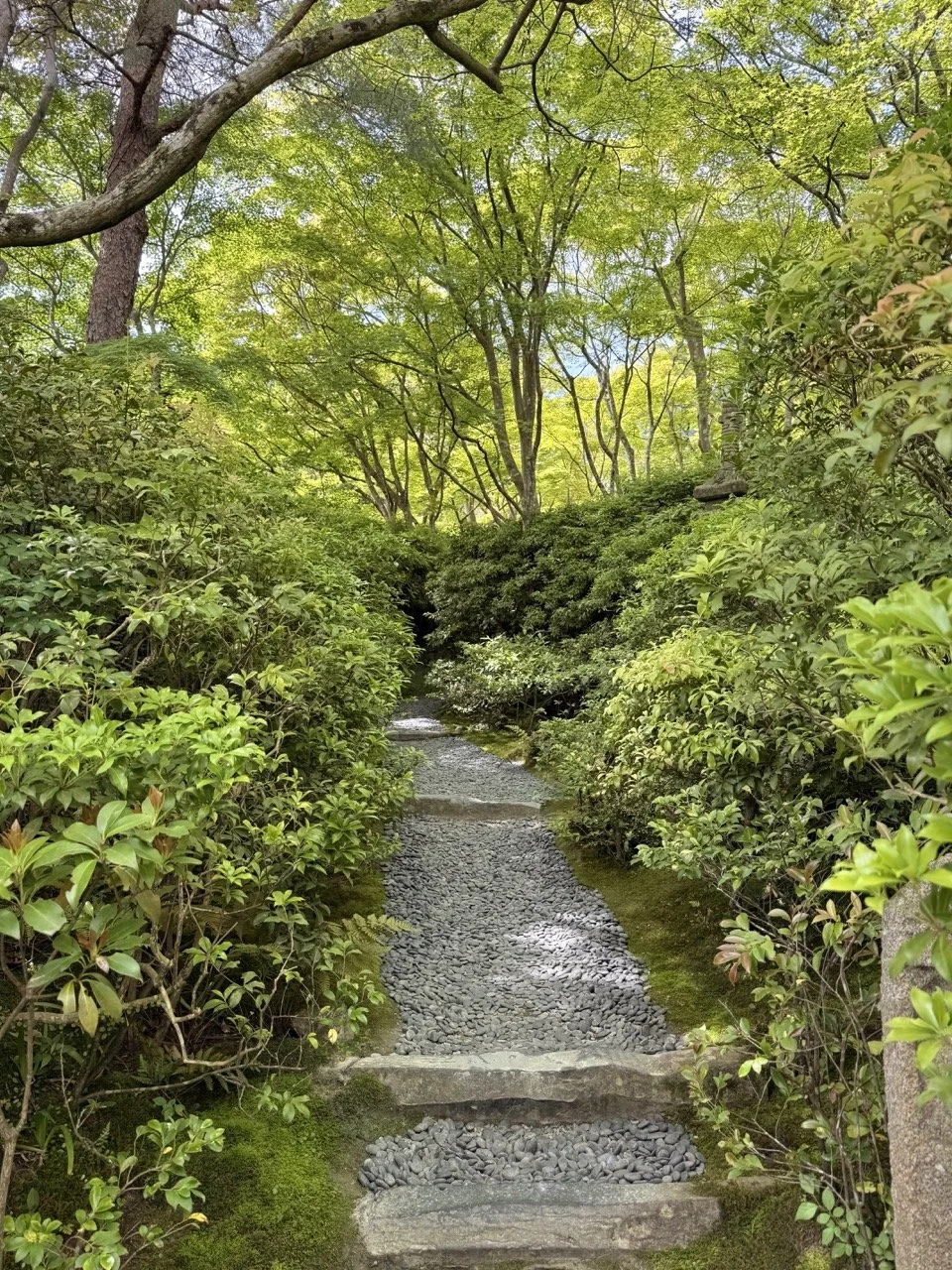
I fell in love with Kyoto’s quiet gardens — the water resting inside stone basins, moss growing between rocks, small bridges, bamboo groves, wooden door frames, free cups of tea offered to visitors. Nothing was trying to impress or overwhelm. Instead, everything seemed devoted to preserving the quiet beauty of everyday life itself.
Throughout the trip, I kept thinking about people.
At Fushimi Inari Shrine, while walking through endless rows of red torii gates alongside crowds of visitors, I kept wondering: where exactly is God? I never saw a clear image of a deity, yet I saw countless people sincerely praying and believing. At one point, a crow landed directly in front of me and stayed there for quite a while. I could feel myself instinctively wanting to assign meaning to it. Human beings really do place their hopes into so many things.
In Nara, I stood before enormous Buddha statues, and later saw handwritten Chinese manuscripts preserved from the Nara period over a thousand years ago. Even after all that time, I could still read the characters. The feeling was surreal, as though time itself had briefly folded inward. Culture and emotion really can travel across centuries.
But what moved me most on this journey was friendship — the kind that survives time.
When I reunited with my middle school best friend in Shinjuku after so many years, it felt as though nothing had changed. We shopped together, ate together, talked endlessly. She warmly opened her home to me, patiently accompanied me around the city, and in the end, she and her husband drove two hours to take us to the airport.
After I entered the airport, she posted this:
“8,000 kilometers from San Francisco to Tokyo.
25 years from age fifteen to forty.
Time has traveled far,
yet somehow we are still who we used to be.
I’m so glad you haven’t changed.
I’m so glad I haven’t changed.
And most of all, I’m glad we are both doing well.”
When I read it, I nearly cried.
To still have a relationship like this in adulthood feels incredibly rare. There is nothing to prove, no image to maintain, no need to walk carefully around each other. Simply sitting together made me realize that perhaps I could still be received gently, the way a teenager once could.
At the end of this trip, I brought home many things. Snacks, gifts, souvenirs, small purchases.
But what I truly brought back was a feeling I had almost forgotten.
I was reminded of the quiet yet profound healing power of friendship formed in youth. It is not dramatic or loud, yet years later, a familiar sentence, a single glance, or one goodbye at an airport can suddenly reconnect you to the younger version of yourself.
For the first time, I also deeply understood that there is beauty in the feeling of time standing still. Some relationships do not disappear because of distance or years. Some emotions simply remain there quietly, waiting until the next reunion to begin flowing again.
And Kyoto — its gardens, temples, bamboo forests, small shops, and slow rhythm — made me want to live more deliberately. To experience life more carefully. To be more present with the people around me.
Like the water resting in a stone basin.
Quiet, yet capable of reflecting the entire world.
(Originally written in Chinese.
English translation created with the help of ChatGPT.)